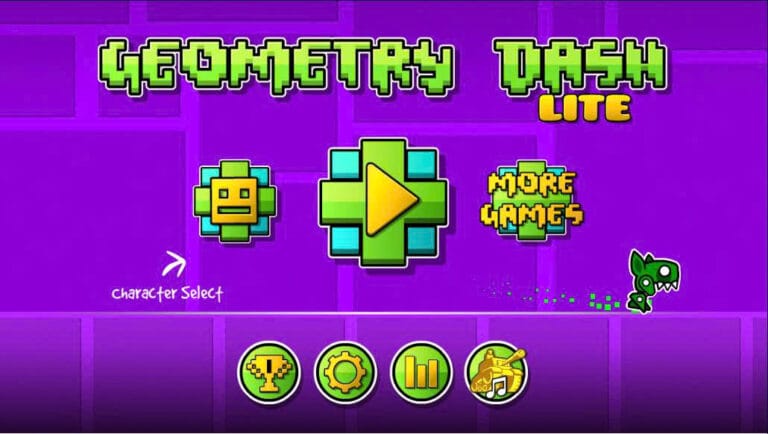
Introduction
There’s something instantly satisfying about a good “geometry jump”—the moment your character snaps from one platform to the next, timed perfectly so the motion feels smooth rather than frantic. It’s not just about speed. It’s about reading shapes, predicting movement, and learning a rhythm that connects your hands, your eyes, and the level’s logic.
If you’ve ever watched people play @Geometry Dash and wondered how they make those jumps look so natural, this guide is for you. We’ll use Geometry Dash as the main example, but the ideas apply to many rhythm-and-platform style games. You can start small, focus on understanding, and eventually feel proud of your own progress—without needing to be “the best.”
If you want to jump in right away, you can check out Geometry Dash then come back here to learn how to experience levels in a way that feels fun instead of stressful.
Gameplay: How to Experience the “Jump”
In Geometry Dash, the core loop is simple: you enter a level, and you react to obstacles as they come. The fun part is how that loop becomes more intelligent over time.
1) Start by listening with your eyes
Even if the music is different from level to level, there’s usually a pattern. Watch how the obstacles appear relative to the beats. Your brain starts to “count” the timing automatically. When you’re new, don’t aim for perfection—aim for consistency. For example, try to survive the first section by focusing on the most obvious hazards (spikes, gaps, and tight corridors).
2) Think of timing as “decisions,” not reflexes
A geometry jump is often one of these decisions:
Jump slightly early so you clear a gap
Jump later to land on a safe platform
Tap consistently to keep moving through a rhythm section
Hold or release at the right instant (depending on the gameplay type)
If you miss, resist blaming your “reaction time.” Instead, treat it like feedback: What did I expect to happen, and what actually happened? That mindset makes retries feel productive.
3) Learn by sections
Levels can be long. The easiest way to stay motivated is to break the level into chunks. You can mentally label them:
Intro pattern (first set of obstacles)
The “jump wall” (where timing gets stricter)
A safer middle (where you can reset your focus)
The final twist (often where players get tripped up)
When you practice, replay only until you reach the failure point, then adjust. This turns each run into a mini-lesson.
4) Let your practice build a “map”
After a few attempts, you’ll start recognizing shapes:
Two spikes close together usually means a quick, specific timing
A long hallway with repeating obstacles often rewards steady rhythm
A slope or orb-like section tends to feel better once you anticipate arcs
The goal isn’t memorization for its own sake. It’s building an internal map so your jumps feel like they belong there.
5) Celebrate progress, not only completion
Completing a level is great, but smaller wins matter:
You reached a checkpoint you never reached before
You stopped dying in the same early spot
Your timing improved even if you didn’t finish
You learned one tricky jump and can now attempt it confidently
This keeps the experience enjoyable, especially when difficulty rises.
Tips: Making Your Geometry Jump Feel Great
Here are practical habits that help you improve while keeping your experience relaxed and positive.
1) Use fewer “panic” attempts
If you repeatedly fail in the same section, pause and reset your approach. Rushing through more attempts can make your timing worse. Instead, replay calmly and watch the obstacle more slowly.
2) Focus on landings
Many players concentrate on the jump itself, but the real challenge is what you land on. Ask yourself: Where am I trying to be when the jump ends? Landing safely often requires different timing than clearing an obstacle by luck.
3) Count beats, then refine
At first, counting helps you stay consistent. Later, refine by micro-adjustments—just a fraction of a beat. You’ll be surprised how often “slightly earlier” or “slightly later” solves a repeated failure.
4) Change one thing at a time
During practice, don’t try to improve everything at once. If you’re failing a jump, test only one adjustment: earlier tap, later tap, different jump height (if applicable), or smoother rhythm.
5) Watch your own failure patterns
If you often die in the same way, you’ve got a clue. For example:
Dying too early suggests you’re jumping before the path needs it
Dying too late suggests you’re waiting too long
Dying off-center suggests your timing is right but your angle/position is off (common in moving or arced sections)
Treat failures as data.
6) Keep it friendly—set a practice limit
If you feel frustrated, stop for a while. A short break can make your next attempt instantly better. The best geometry-jump experience is one you return to willingly.
Conclusion
Learning to play Geometry Dash (or any geometry-style jump game) is less about “being good” from day one and more about enjoying the process of timing, pattern recognition, and gradual improvement. When you approach jumps like decisions, practice in sections, and build a mental map of obstacles, the game becomes clearer and more satisfying.
The next time you try a level, aim for a personal goal: survive longer, land cleaner, and understand the rhythm of a tricky jump. Completion will come naturally when your confidence grows.
Sorry, no records were found. Please adjust your search criteria and try again.
Sorry, unable to load the Maps API.
